
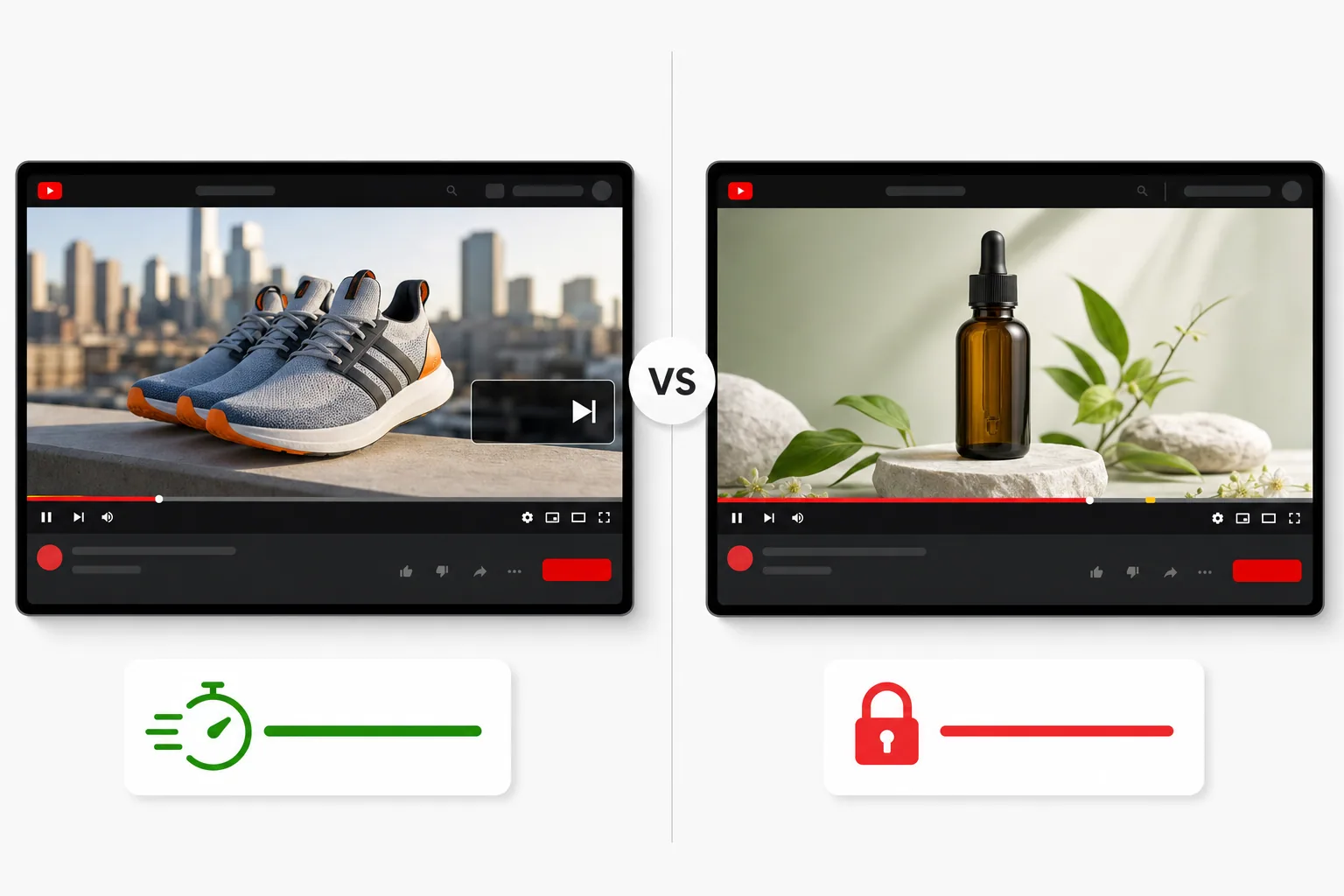
When you're running YouTube ads at scale, format decisions matter as much as budget allocation. The choice between YouTube unskippable ads and skippable ads isn't just a creative preference, it's a performance lever that moves your ROAS, CAC, and overall account profitability.
In this guide, we'll break down both formats, show you the tradeoffs, and help you decide which one wins for your business.
What Are YouTube Unskippable Ads?
YouTube unskippable ads are in-stream ads that viewers must watch in their entirety before they can access the content they came for. These are the 15 or 20-second spots that play automatically, no skip button in sight.
Unskippable ads force completion. Your message gets 100% of attention from 100% of viewers, assuming they don't close the tab. That forced attention is the entire value proposition: you pay per impression, not per click, and you get guaranteed exposure.
The tradeoff is straightforward: lower cost per impression, but higher bounce risk and potential for viewer frustration if the ad doesn't deliver value fast.
What Are YouTube Skippable Ads?
Skippable ads (also called TrueView in-stream ads) let viewers skip after five seconds. You only pay when someone watches 30 seconds or interacts with your ad, not on the initial impression.
This format rewards creative excellence and relevance. If your hook is weak, users skip, you don't pay. If your hook lands, you pay only for engaged viewers. It's performance-aligned from the start.
Skippable ads typically cost more per engaged view, but you're paying for intent, not just eyeballs. That matters when you're scaling serious budgets.
Key Differences at a Glance
| Attribute | Unskippable | Skippable |
|---|---|---|
| Length | 15-20 seconds | 20-120 seconds |
| Skip Option | No | Yes, after 5 seconds |
| Cost Model | CPM (per 1000 impressions) | CPCV (per view over 30 sec) |
| Completion Rate | ~100% (forced) | 40-60% (depends on creative) |
| Best For | Brand awareness, top-of-funnel | Direct response, conversions |
| Audience Sentiment | Mixed (can feel intrusive) | Better (earned attention) |
When to Use Unskippable Ads
Unskippable ads win when your goal is reach and frequency at minimum cost. They're ideal for:
- Brand awareness campaigns where you need to move a metric like view volume
- Announcement campaigns launching a new product or offer
- Retargeting warm audiences who've already engaged with your brand
- Campaigns where your hook is visual or emotional, not narrative (think a 15-second product shot)
The math works when your impression cost is low enough that even a modest click-through rate or conversion rate justifies the spend. If you're running seven-figure budgets across multiple product launches, unskippable ads can be a fast way to test whether a creative angle resonates at scale.
The risk: if your message is unclear in 15 seconds, viewers close the tab and move on. You don't get the data signal you'd get from a skippable ad where users actively choose to engage.
When to Use Skippable Ads
Skippable ads win when your goal is efficiency and conversion. They're ideal for:
- Direct-response campaigns driving to a landing page or checkout
- Product demonstrations where you need more than 15 seconds to show value
- Funnel stages where you're paying for actual consideration, not just awareness
- Testing new creative angles without paying for viewers who skip immediately
Skippable ads give you a cleaner signal: if your CTR or conversion rate is low, you know your creative needs work. The 30-second threshold ensures you're only paying for viewers who stayed engaged.
When you're running eight-figure ad budgets across Meta, Google, and TikTok, that efficiency compounds. One percent improvement in your YouTube CAC means tens of thousands of dollars in monthly savings when scaled across your entire account ecosystem.
The Real Performance Factor: Creative Quality
Here's what most advertisers miss: the format matters less than the creative itself.
A weak skippable ad gets skipped at 85% within five seconds. You pay nothing, but you learned nothing except that your hook doesn't work. A strong skippable ad gets a 50% view-through rate and drives conversions at a tight CAC.
An unskippable ad with a poor message gets completed by 100% of viewers and generates zero interest. You paid for eyeballs that weren't engaged.
The creative leverage point is the hook. In the first five seconds of any in-stream ad, you need to answer one of these questions:
- What problem am I solving?
- What outcome am I promising?
- Why should you care right now?
If you nail that in five seconds, both formats perform. If you don't, skippable ads at least give you cheap data to iterate.
Hybrid Strategy: Combining Both Formats
The highest-performing teams don't pick one. They run both in parallel and let account-level data decide allocation.
Deploy unskippable ads to new audience segments where you're testing reach. Run the same creative as a skippable ad to measure engagement and conversion. Compare the CAC and ROAS. If skippable converts better, shift budget. If unskippable wins on volume and still drives conversions, scale it.
This parallel testing approach is faster than writing strategy decks about which format "should" work. You learn by spending and reading the numbers, not by debating.
Optimization Tactics for Both Formats
Once you've chosen your format, the work shifts to dailyiteration. Here's what moves the needle:
-
Test multiple hook variations within the same ad. Change the first 5-10 seconds, keep the rest constant. See which hook gets the lowest skip rate or highest CTR.
-
Segment by audience intent. New audiences may need more hand-holding. Retargeted users may respond better to direct asks.
-
Test duration strategically. A skippable ad doesn't need 120 seconds if your product story lands in 45. Shorter ads often drive higher completion and lower cost per view.
-
Layer your funnel behind the ad. If your post-click page is weak, your ad format choice doesn't matter. Losers killed in week one of your campaign should include both underperforming ads and underperforming landing pages.
Quick Wins for Your Next Campaign
If you're launching YouTube ads this month, start with skippable in-stream ads if you're optimizing for conversion. You'll get faster feedback on creative quality and a cleaner CAC signal. Run unskippable ads to retargeting audiences who've already warmed up to your brand, where completion and frequency matter more than engagement.
Don't overthink the format choice. Pick one, test it hard, measure it daily, and adjust. Most advertisers spend weeks debating strategy and days actually optimizing. Reverse that ratio and your account will move faster than accounts run by teams twice your size.
Your next winning campaign probably won't be built on the perfect format decision. It'll be built on ruthless weekly iteration, aggressive testing of creative angles, and the speed to kill underperformers within 48 hours. The format you choose matters. The discipline to iterate relentlessly matters more.