
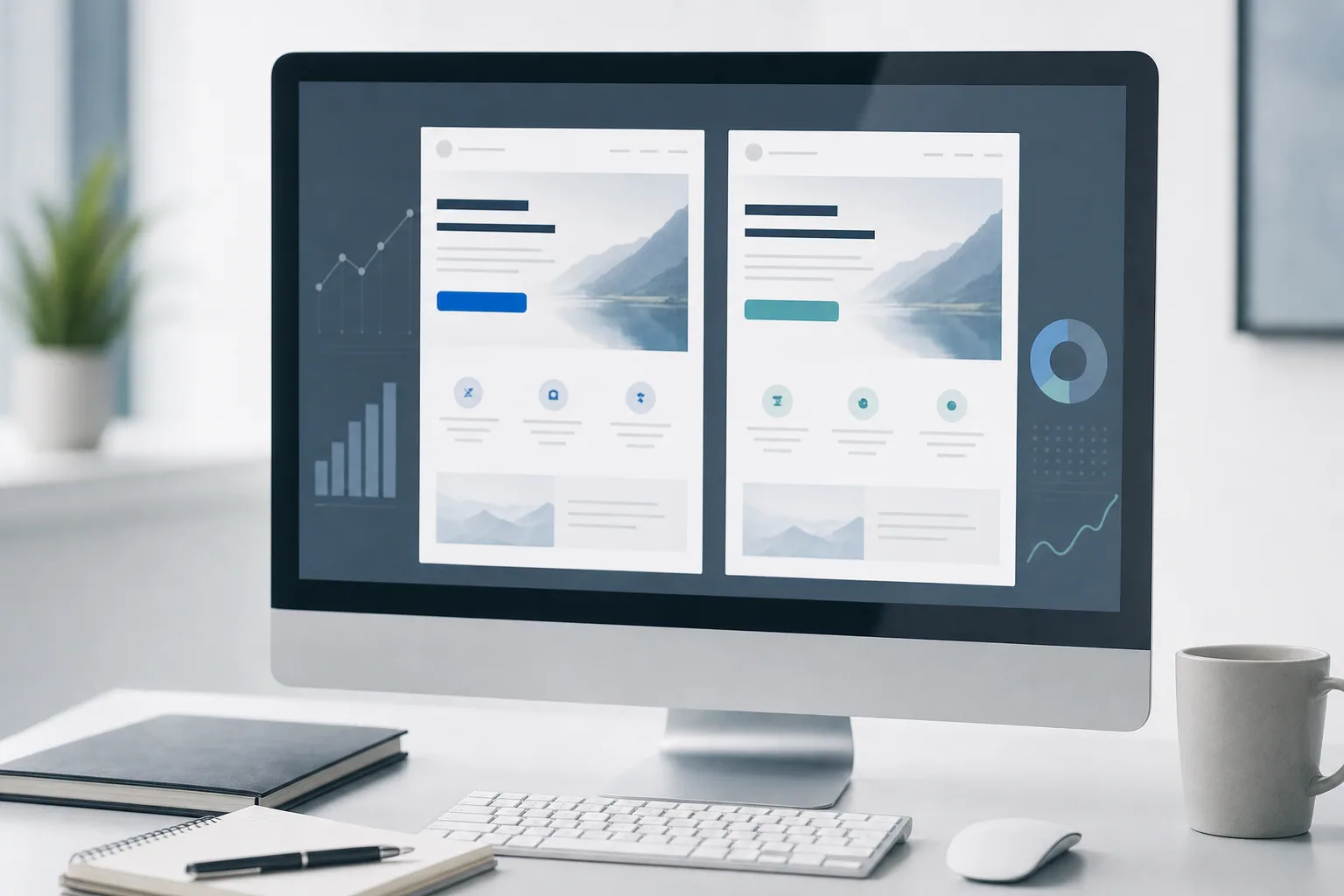
Why Landing Page Split Testing Matters
Your ad account can be firing on all cylinders, but if your landing page converts at 2% instead of 5%, you're leaving money on the table. Split testing, or A/B testing, is how you find out which version actually works with your audience.
Most brands treat their landing pages like static assets. They build one, launch it, and assume it's done. Meanwhile, your competitors are iterating daily, killing underperformers within 48 hours, and scaling the winners aggressively. The gap between a brand that tests and one that doesn't compounds fast.
Landing page split testing works best when it's wired tightly to your ads. Your page should learn as fast as your account does. When your creative, audience, and funnel all move in parallel instead of in sequence, you compress the feedback loop from weeks to days.
What to Test First
Not all elements on your landing page carry equal weight. Test the high-leverage items first, the ones that move the needle on conversion rate.
Primary Elements to Test
- Headline - The first thing visitors read. A weak headline kills conversions before the body copy even matters.
- Call-to-action button - Text, color, size, and placement all affect click-through rates. Test "Buy Now" against "Claim Your Spot" or "Start Free Trial."
- Hero image or video - Your visual hook. A demo video often outperforms a static image, but test both.
- Copy length - Some audiences respond to long-form, others to short-form. Your traffic source (Meta, Google, TikTok) often signals which one to lead with.
- Value proposition - How you position the core benefit. "Save 10 hours per week" hits different than "Increase productivity."
- Social proof - Testimonials, case studies, or user counts. Position them above or below the fold, and test how many to include.
Start with one variable per test. If you change the headline AND the CTA button AND the image at the same time, you won't know which change drove the lift. Single-variable tests are slower but they teach you what actually works.
Setting Up Your A/B Tests
A proper split test needs a structure. Random changes don't teach you anything.
The Setup Process
- Define the metric. Are you optimizing for form submissions, email signups, purchases, or add-to-cart events? Be specific. Your funnel diagnostics should tell you which step matters most.
- Choose your sample size. Don't kill a test after three days or 100 visitors. Aim for at least 100 conversions per variation before you declare a winner. This takes time, but the data is sound.
- Run both versions in parallel. Don't run variant A for two weeks, then variant B for two weeks. Traffic patterns shift. Run them side-by-side for the same period, ideally one to two weeks minimum.
- Account for statistical significance. A 20% lift on 50 conversions might be noise. A 20% lift on 500 conversions is real. Use a significance calculator if you're unsure.
- Track cohorts, not total traffic. When you split test, traffic randomization matters. If all your paid visitors see variant A and all your organic visitors see variant B, you're conflating traffic source with page performance.
How Brands Make Testing Mistakes
Speed is good. Recklessness is not. Here's where most teams go wrong:
Testing too many things at once. You change the headline, the CTA copy, the image, the form fields, and the color scheme. When variant B wins, you don't know which change caused it.
Stopping tests too early. You see a 10% lift after a week and think you've won. But week two shows a 5% lift, and by week three it's back to baseline. Sample size matters. Patience matters.
Not testing enough variants. Some teams A/B test once, see a result, and stop. Real optimization is continuous. Test three to five variants in parallel, kill the losers, and push the winners harder.
Ignoring audience signals. The same landing page rarely works for cold traffic and warm traffic. Test different versions for different audiences. Your first-time visitor needs more proof than someone who already knows your brand.
The Iteration Tempo That Works
Iteration speed separates high-growth brands from stalled ones. Most agencies batch test updates and roll them out monthly. Fast operators iterate weekly or even daily.
Here's the tempo that produces results: Deploy multiple page variants by the end of your first week. Read the data daily. Kill losers inside 48 hours. The variants that show promise get more traffic and tighter tracking. By the end of week two, you'll have a clear winner and a backup variant ready to test against it.
This works especially well when your landing page changes are wired to your media buying strategy. Your ads test new creative angles. Your page tests new frames and offers. When both move in parallel, not in sequence, you find product-market fit faster.
Testing Across Traffic Sources
The traffic source you use shapes the landing page that works. Meta audiences expect different messaging than Google audiences, and TikTok audiences often want something different still.
Meta traffic tends to skew younger and more attention-starved. Short copy, strong visuals, and fast hooks work. Google traffic is often higher-intent. Longer copy, specific benefits, and trust signals convert better. TikTok audiences want authenticity and entertainment value, even on a sales page.
Don't assume one page works everywhere. Test a short-form variant for your Meta traffic and a long-form variant for your Google traffic. Segment your tests by platform, and let each platform teach you what it wants.
Making the Decision to Scale or Kill
Once you have data, the choice is simple: scale the winning variant or kill the loser. No sentiment attached.
If variant A converts at 5% and variant B converts at 3.2%, stop sending traffic to variant B. Double down on variant A. Most clients see their top-performing variant outspend the rest 10:1 by the end of the first month.
But don't rest. The moment you stop testing, your competitors start iterating past you. Your winning variant today is your baseline tomorrow. Queue up your next test. The second-best version you tested becomes your control. Pit it against two new variants. Keep moving.
Next Steps
Landing page split testing only pays off when it's connected to a larger system: your ads, your funnel diagnostics, your creative strategy, and your budget allocation. Testing in isolation produces marginal gains. Testing as part of a coordinated account strategy produces exponential returns.
If you're running five figures or more in monthly ad spend, your landing pages should be under constant test. If you're running eight figures, they should be under weekly evaluation. The faster you iterate, the faster your conversion rate climbs, and the lower your customer acquisition cost falls.
Ready to turn your landing pages into conversion machines? Start with a 72-hour account teardown that diagnoses which lever moves first: creative, audience, or page. Once you know where the opportunity is, your testing roadmap becomes clear.