
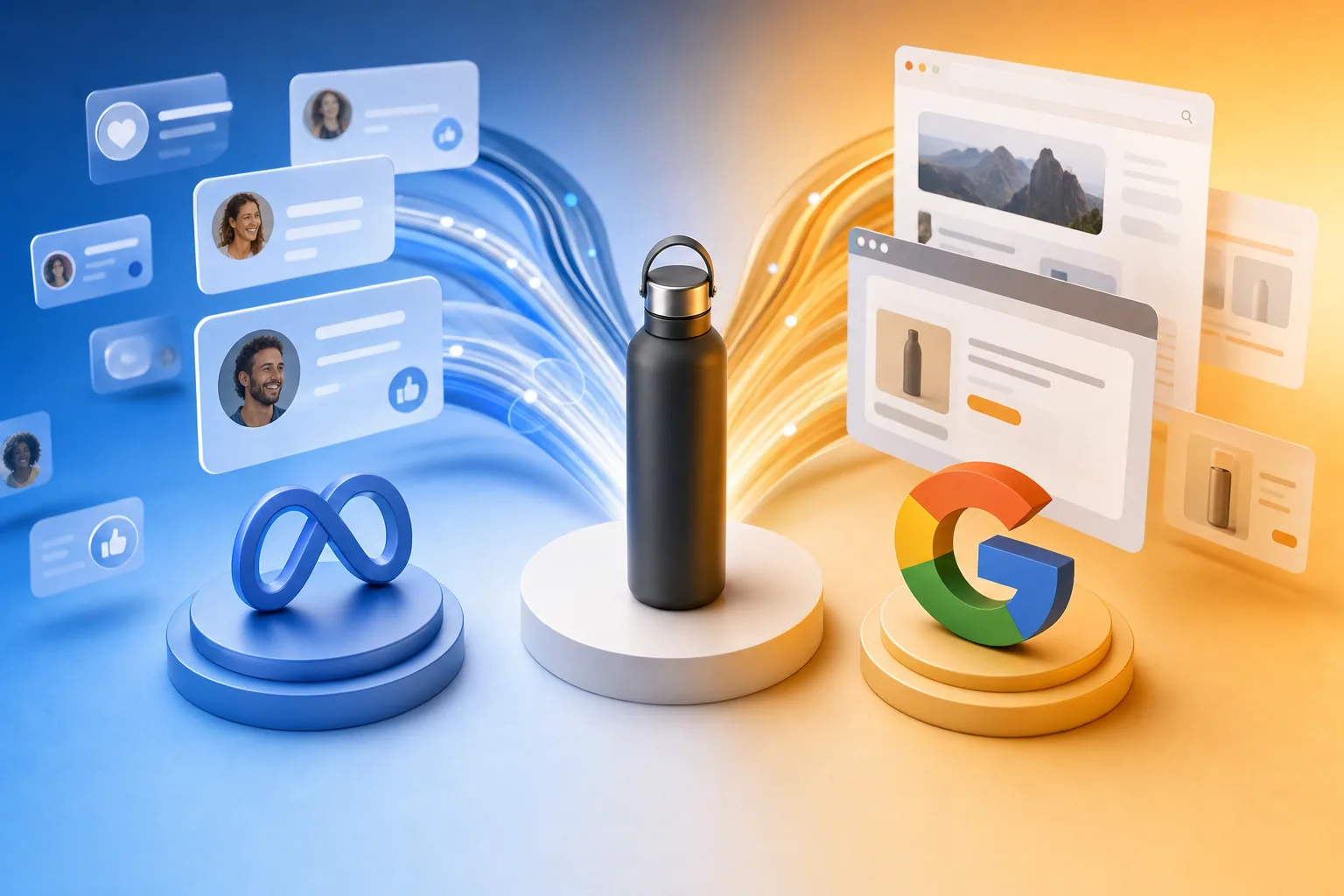
Most DTC founders face the same question when scaling ad spend: should I go all-in on Meta Ads, Google Ads, or split my budget between them? The answer matters because each platform behaves differently, reaches customers at different moments in their journey, and requires distinct creative and messaging approaches.
At Vential Marketing, we deploy eight-figure budgets across Meta, Google/YouTube, and TikTok for DTC brands, and the pattern is clear: the best performers never choose one. They optimize both, run them as a system, and let each platform do what it does best.
How Meta Ads and Google Ads Work Differently
Meta Ads (Facebook and Instagram) and Google Ads serve fundamentally different advertising models, and understanding the gap is crucial before you invest.
Meta Ads are intent-agnostic. You're interrupting someone scrolling their feed. Meta's strength is audience targeting: it knows who someone is, what they like, where they live, what they've clicked on, and how they behave. You build an audience based on interests, behaviors, lookalike models, and pixel data, then show them creative designed to stop the scroll and create desire.
Google Ads, by contrast, are intent-driven. Someone searches for 'waterproof phone case' or 'organic skincare for sensitive skin' and Google shows your ad because you bid on that exact keyword or search intent. You're not interrupting. You're answering a question the customer is already asking.
This difference shapes everything: your creative strategy, your targeting approach, your landing page design, and your expected cost per acquisition.
Meta Ads: Best for Building Desire and Awareness
Meta excels when your customer doesn't yet know they need you. If you're launching a new product category or introducing a brand to a cold audience, Meta is where you test creative and find product-market fit.
Strengths of Meta Ads for DTC:
- Video-first creative gets the highest engagement and lowest cost per view
- Lookalike audiences built from your best customers scale predictably
- Detailed audience segmentation by interest, behavior, and demographics
- Lower cost per click in most DTC verticals (wellness, fashion, apparel, supplements)
- Retargeting is highly efficient once your pixel data matures
- Real estate for longer-form storytelling and hook-driven creatives
Meta works best when you have strong creative. That means hooks that stop the scroll, clear value propositions, and video that demonstrates your product or tells a story. If your creative is weak, Meta's cost per acquisition climbs fast.
Google Ads: Best for Capturing High-Intent Customers
Google Ads are for customers ready to buy or actively comparing options. These are your highest-intent prospects, and they convert at better rates than cold audiences on Meta.
Strengths of Google Ads for DTC:
- Capture search intent at the moment of decision
- Higher average order value and conversion rates from search traffic
- Keyword targeting lets you reach customers looking for your exact solution
- Shopping campaigns showcase product images, price, and reviews directly
- Lower cost per conversion in many cases, despite higher cost per click
- Brand keyword campaigns protect against competitor attacks
- YouTube ads reach intent-based audiences with video content
Google Ads work best when you have a refined product, proven funnel, and clear messaging about what problem you solve. If your product is new or unproven, you'll burn through budget on Google because search volume is low and cost per click is high.
Meta Ads vs Google Ads: Direct Comparison
| Factor | Meta Ads | Google Ads |
|---|---|---|
| Customer Intent | Low to medium (awareness, consideration) | High (active search, ready to buy) |
| Best For | New products, cold audiences, creative testing | Proven products, high-intent capture, brand protection |
| Cost Per Click | Lower, typically 0.50-2.00 | Higher, typically 1.00-5.00+ |
| Conversion Rate | Medium (1-3% for cold, 5-15% for warm) | Higher (3-8% for search, 2-5% for shopping) |
| Creative Requirements | Strong hooks, video, storytelling | Clear copy, product images, competitive messaging |
| Learning Curve | Medium (audience building, pixel optimization) | High (keyword research, bid strategy, negative keywords) |
| Best For Scaling | Lookalike audiences, retargeting | Search volume growth, new keywords |
The Real Play: Run Them Together
The question 'Meta Ads vs Google Ads' is a false choice for most DTC brands running serious budgets. You need both because they own different parts of your customer journey.
Here's how most high-growth DTC brands structure it:
Top of funnel (awareness): Meta Ads with creative angles, lookalike audiences, and video content. Test product angles, messaging, and hooks. Cost per result is low. Volume is high.
Middle of funnel (consideration): Retargeting on Meta to people who engaged with your ads but didn't convert. Video views, lead magnets, case studies.
Bottom of funnel (conversion): Google Shopping and search ads to capture people actively looking for your product type or searching your brand name. Cost per acquisition is higher, but conversion rate justifies it.
Protection: Brand keyword campaigns on Google to own your search real estate and block competitors.
When you run them in parallel, not in sequence, you compress your sales cycle and reduce overall customer acquisition cost. Your Meta ads build awareness and drive pixel data. That pixel data powers your Google retargeting and lookalike audiences. Your Google ads prove which customers actually have intent. You iterate your Meta creative based on what Google proved converts.
Vential Marketing manages this three-platform ecosystem for 100+ clients because most agencies treat each channel as a separate vendor relationship. Your Meta vendor doesn't know what Google learned. Your Google team doesn't see your Meta creative data. That siloing costs you 20-40% of potential profit.
Getting Started: Which Should You Test First?
If you're just starting, test based on where your customer is loudest:
- New product launch with no customer data: Start with Meta to build your pixel and test creative angles
- Established product with proven funnel: Start with Google to capture high-intent search traffic
- Plenty of budget and no time pressure: Launch both in parallel, measure weekly, shift budget to the winner
The key is speed and iteration. You'll learn more from two weeks of spending across both platforms than from two months of strategy and planning. Deploy multiple angles on Meta, capture intent signals on Google, kill losers inside 48 hours, and scale the winners.
Common Questions About Platform Choice
One last point: if you're running $100k+ monthly ad spend and managing Meta Ads vs Google Ads yourself, you're leaving profit on the table. The compounding effect of parallel optimization, daily creative iteration, and cross-platform audience leverage is not something a single operator or generalist agency can sustain.
Vential Management handles account architecture, daily optimization, creative strategy, and funnel diagnostics across Meta, Google, and YouTube so they work as a system. Our first 72 hours are spent diagnosing which lever moves first for your account: creative, audience, or page. Then we deploy fast, iterate ruthlessly in weeks two and three, and scale the survivors in week four.
If you're ready to move beyond the Meta Ads vs Google Ads question and actually scale both together, book a conversation with Andreas to see if there's a fit.