
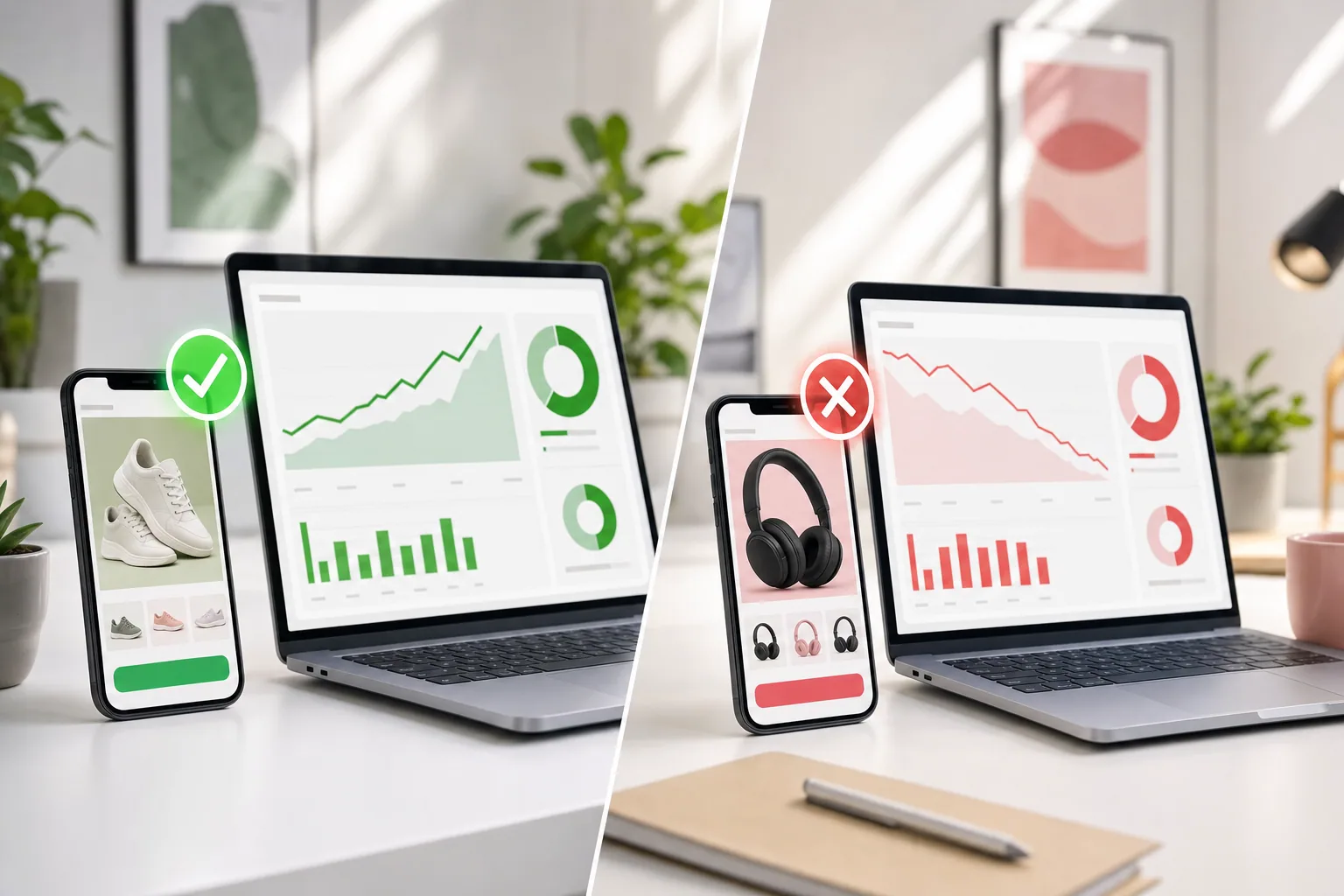
A/B testing is not about running experiments and seeing what happens. It's about making deliberate decisions with real money on the line, killing what doesn't work within 48 hours, and pouring budget into what does.
If you're running paid ads across Meta, Google, or TikTok, you already know that creative, audience, and funnel changes move your numbers. What separates brands that scale profitably from those that plateau is velocity: how fast you can test, read the data, make a call, and move budget.
Here's how to build an A/B testing framework that actually works at scale.
Know What to Test First
Not everything deserves a test. Vanity testing, like running five headline variations at equal budget to see which gets the most impressions, wastes money. Real A/B testing on paid ads focuses on the levers that move your core metric: ROAS for eCommerce, CAC for SaaS, or revenue per customer for course creators.
The priority order matters:
- Creative moves fastest. A winning hook, angle, or visual pattern can shift your ROAS 2-3x in a week.
- Audience signals come next. Platform targeting, lookalike audiences, or broad audiences with good creative can unlock new volume.
- Funnel and checkout matter, but they move slower. Test these in parallel with creative and audience work, not in sequence.
Inside your first 72 hours, diagnose which lever needs the pull. Most brands find their funnel is fine and their audience is broad enough, but their creative is stale. Start there.
Structure Tests That Actually Teach You Something
Proper A/B testing requires isolation. Change one variable at a time, or your data tells you nothing.
If you change your headline, your image, your audience, and your landing page all at once, and your ROAS goes up, you don't know which change did it. Next time, you'll guess. That's not a business. That's gambling.
Instead:
- Hold your audience, landing page, and funnel constant. Test two creative angles against each other.
- Run them at equal budget so you get statistical relevance in days, not weeks.
- Let them run for 72 to 120 hours minimum. Platforms need data to optimize, and you need data to decide.
- Watch for early clues: click-through rate, cost per click, video completion rate, or landing page bounce. These lead ROAS by 24-48 hours.
Once you have a winner, create variations on the winning angle rather than pivoting to something completely new. If a dancing hook outperforms a talking-head hook, test different dancers and different music. You're doubling down on what works, not chasing bright objects.
Kill Losers Fast, Scale Winners Faster
The agencies that move slowly wait for a full month of data before making a call. By then, their client has burned thousands on a creative that never had a shot.
Vential Marketing treats this differently. Losers get killed inside 48 hours. If a creative isn't hitting your benchmark cost per purchase or cost per lead by the second day, pause it and redeploy that budget to a test that might work.
This doesn't mean flip-flopping. It means having clear KPI targets before the test starts. Know what your benchmark ROAS is, know what your historical cost per acquisition is, and know what success looks like. When you hit those metrics at scale, you're golden. When you don't see them trending that way by 48 hours, the creative isn't going to recover.
Once you find a winner, the move is aggressive. Most clients see their top creative outspend the rest 10:1 by the end of the first month. That's not greed. That's reading data and moving budget to high-intent volume.
Test Across Platforms in Parallel, Not in Sequence
Most brands operate Meta, Google, and TikTok like three separate businesses. They run a test on Facebook, get results in a month, then port it to Google, then to TikTok. By the time they've learned anything, their competitor is three iterations ahead.
Instead, run your tests across all three platforms at the same time. The same creative angle, the same audience structure, the same landing page. You'll see which platform rewards it first, and you can double down there while you're still learning on the others.
Not every creative wins on every platform. A short-form video hook might explode on TikTok and flop on Google Search. A long-form VSL might crush on Facebook and underwhelm on TikTok. Running tests in parallel teaches you platform behavior fast, so you can allocate budget to your best channels before your testing period is over.
Build Momentum by Iterating Every Week
A/B testing is not a one-time thing. It's a weekly cadence. By the end of week one, you should have multiple angles live. By the end of week two, you should have killed half of them and created two new variations based on what you learned. By the end of week three, you're ruthlessly iterating: new hooks, new headlines, new audience signals, same landing page or a new funnel variant.
This is where most vendors stop working. Vential keeps going. Parallel iteration, not waterfall.
The rhythm is simple:
- Monday through Wednesday: read your weekend and early-week data, identify what's working and what's flat.
- Thursday: kill losers, create new variations, brief the team.
- Friday through Sunday: new tests are live, you're learning what moves.
- Next Monday: repeat.
Inside four weeks, you've run dozens of iterations, found your winners, and scaled them. Inside four months, you've built an unfair advantage because you're moving ten times faster than the agency that waits for monthly reports.
Track the Right Metrics
Not every metric matters. If you're optimizing for clicks, you'll win on cost per click and lose on revenue. If you're optimizing for impressions, you'll get tons of views and zero conversions.
Optimize for one metric: return on ad spend (ROAS), cost per acquisition (CPA), or revenue per customer. Everything else is a leading indicator.
- Early indicators: click-through rate, video completion rate, cost per click, landing page bounce rate.
- Middle indicators: cost per lead, cost per trial, conversion rate.
- True outcome: ROAS, CAC, or revenue per customer.
Watch the early indicators for real-time signals. But make your kill/scale decision based on the true outcome. If your CPC is great but your ROAS is trash, pause it. The platform optimized for the wrong thing.
Final Word
A/B testing is not academic. It's survival. Every dollar you spend on a test that fails is a dollar you could have spent on a test that wins. The brands that scale fastest aren't smarter. They're faster. They test more, they kill losers quicker, and they double down on winners without hesitation.
If you're running real ad budgets and you're not iterating at this velocity, you're leaving money on the table. Start this week: diagnose your account in 72 hours, deploy multiple angles by end of week one, and kill losers by day two of week two. The compounding effect hits hard.